

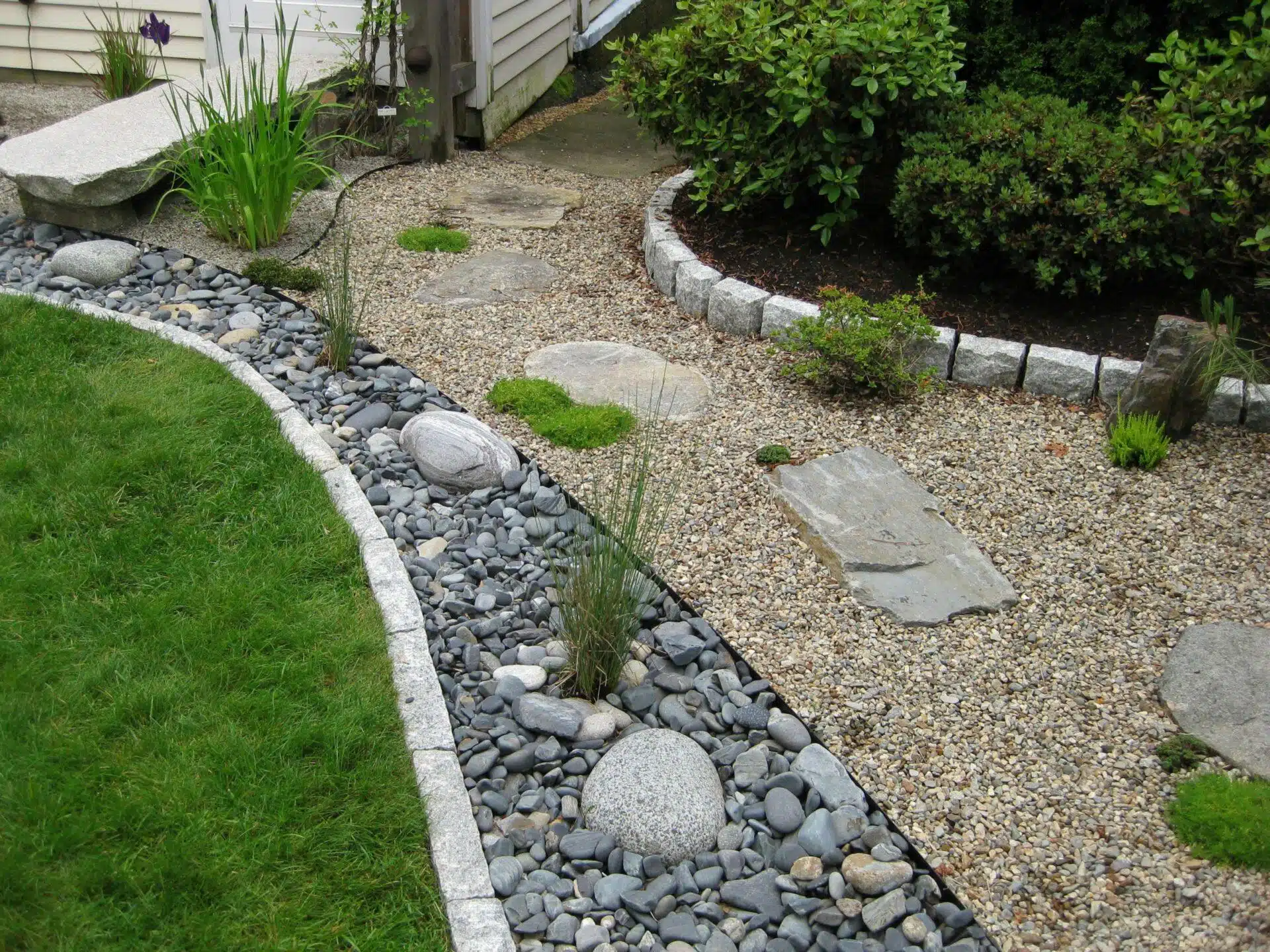
The Complete Guide to Landscape Drainage: How to Protect Your Property from Water Damage
Your outdoor space is one of the most valuable parts of your home, and most homeowners are pretty thoughtful about protecting it. You invest in quality materials, you maintain the lawn, you plan projects carefully. But there’s one piece of the puzzle that tends to get overlooked until it becomes a problem: drainage.
Proper drainage is quietly one of the strongest protections you have for your home’s long-term value. Drainage problems are among the most common issues flagged during home inspections and appraisals, and they have a way of surfacing at the worst possible time, like right when you’re trying to sell.
The good news is that most drainage challenges are very solvable, especially when you catch them early and approach them the right way. This guide walks you through everything you need to know — how to spot the warning signs, which solutions work best for which situations, and when it makes sense to bring in a professional. Think of it as the resource you’ll wish you’d had before the problem started.
Why Landscaping and Drainage Go Hand in Hand
Most homeowners think of landscaping and drainage as two separate things. One is about beauty, the plants, the stone, the patio. The other is about function, the pipes, the slope, the water flow. But the reality is, every single landscaping decision you make affects how water moves through your property.
The grade of your lawn determines where water flows after it rains. The type of plants and ground cover you choose affects how well the soil absorbs water. Where you install a patio or retaining wall can either channel water away from your home or create a new problem area you didn’t see coming. Even your mulch depth plays a role.
When these elements are designed together, with drainage as part of the plan from the very beginning, the result is a yard that looks stunning AND performs reliably in every season. When drainage is an afterthought, or never considered at all, you end up playing defense after every rain event.
Beyond the lawn itself, poor drainage can create serious damage to your home’s foundation. Water that sits against a foundation wall for extended periods puts hydrostatic pressure on the structure, which over time can cause cracking, bowing, and basement water infiltration. That’s a structural problem. And the repair costs that come with it are rarely pretty.
The best outdoor spaces are designed to hold up, drain properly, and protect your investment for the long haul. That’s the kind of thinking that separates a truly exceptional outdoor space from one that just looks good in photos.
Warning Signs Your Yard Has a Drainage Problem
Sometimes drainage issues announce themselves loudly, a flooded basement, a completely waterlogged lawn after a normal rainstorm. But more often, the signs are subtle at first, easy to brush off until they compound into something more serious.
Here are the warning signs worth paying attention to:
- Standing water that lingers. A little pooling right after a heavy downpour is normal. But if water is still sitting in the same spots 24 to 48 hours after rain has stopped, that’s a clear sign the ground isn’t draining the way it should.
- Spongy or perpetually soggy lawn patches. Walk your yard a few days after rain. If certain areas feel soft and mushy underfoot, or if your shoes sink into the grass, that soil is staying saturated far too long. Over time, those areas won’t support healthy turf growth, and you’ll end up with bare, muddy patches no matter how much you reseed.
- Erosion channels forming in the lawn or beds. These are the small gullies or ruts that form when water is consistently running over the same path with enough velocity to carry soil with it. You’ll often see them running down slopes, along driveways, or through landscape beds. Left unaddressed, they get wider and deeper with each rain event.
- Washed-out mulch and displaced soil. If you find your landscape bed mulch scattered across the patio or driveway after every storm, surface runoff is moving through your beds with more force than it should. This doesn’t mean your plants’ root systems are being disturbed and your soil is gradually eroding.
- Water staining or moisture near the foundation. Dark staining along the base of your home’s exterior, efflorescence (white mineral deposits) on basement walls, or unexplained humidity and musty odors in the basement are all signs that water is finding its way toward or into your foundation.
- Dying plants in areas that should be thriving. If certain plants keep struggling despite proper care, waterlogged roots may be the culprit. Most plants simply cannot survive in chronically saturated soil, their roots suffocate. This is especially common in low-lying areas of the yard.
If any of these sound familiar, you’re not alone, and more importantly, these problems are solvable. The sooner you address them, the less damage you’ll be dealing with down the road.
The Most Effective Yard Drainage Solutions
The good news is that there’s no single “drainage solution” that works for every yard, which actually means there’s a right answer for your specific situation. Here’s a look at the most commonly used yard drainage solutions and what each one is best suited for.
French Drains
A French drain is one of the most reliable solutions for chronic subsurface water problems. It consists of a perforated pipe wrapped in filter fabric, surrounded by gravel, and buried in a trench. Water that saturates the soil seeps into the gravel, enters the pipe, and gets redirected away from problem areas, typically to a storm drain, dry well, or a lower area of the property where it can dissipate safely.
French drains are particularly effective for yards with a high water table, areas that stay soggy for days after rain, and properties where water is collecting near the foundation. They do their work underground and, once installed, are essentially invisible.
Surface Channel Drains
If your drainage issue is primarily about surface runoff, water that flows across the top of hardscaped areas like patios, driveways, or walkways, a surface channel drain (sometimes called a trench drain) is often the right call. These are narrow, linear drains installed flush with the surface that catch water before it can pool or flow toward the home.
They’re especially common at the base of sloped driveways, along the edges of patios, and at entry points to garages. Done well, they blend into the hardscape and are barely noticeable.
Dry Creek Beds
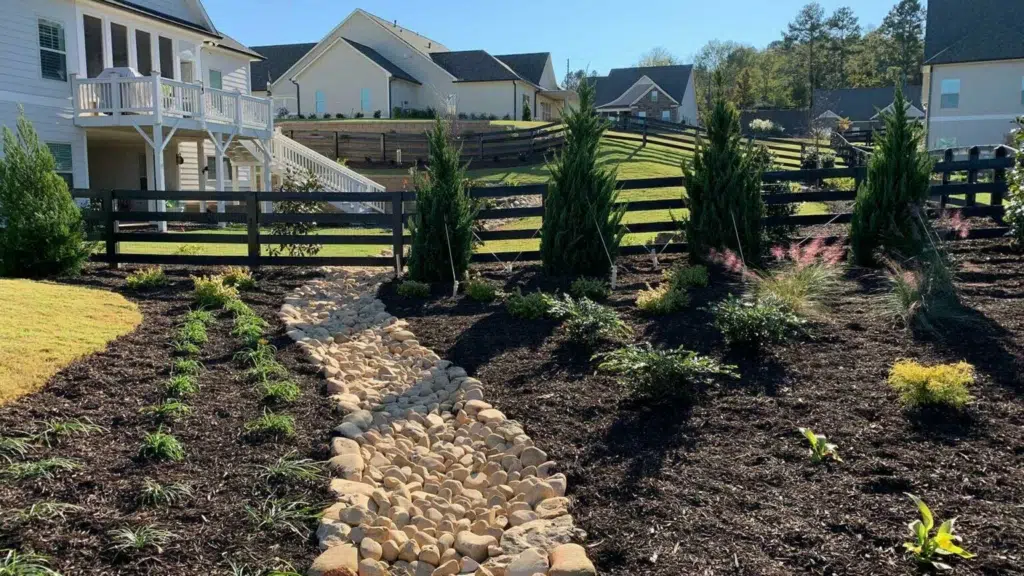
This is one of our favorite solutions because it solves a functional problem while actually adding visual interest to the landscape. A dry creek bed is essentially a channel lined with decorative rock and river stone that mimics a natural stream. During rain events, it carries surface water runoff away from problem areas and disperses it gradually. When it’s dry, it looks like a beautiful, intentional landscape feature.
A dry creek bed is an ideal solution if you have a consistently saturated low spot in the yard, erosion from surface water runoff, or a slope that channels water across the property. It’s also a smart way to direct roof runoff away from the foundation without running an eyesore of exposed pipe through your yard. For more on this solution, check out our article: Dry Creek Beds 101: Form Meets Function in Landscape Design
Downspout Extensions and Redirects
Your roof sheds an enormous amount of water during a storm, and your gutters and downspouts are responsible for getting all of that water away from your home. If your downspouts terminate right at the foundation, that water is concentrated into one area and has nowhere to go but down — and eventually, in.
Extending downspouts with underground pipe to carry water at least six to ten feet away from the home is a relatively simple fix that makes a significant difference. In some cases, this pairs beautifully with a dry creek bed feature that carries the water further into the yard.
Regrading
Sometimes the issue is that the ground itself is sloped toward the home rather than away from it. Proper grading means the ground surface near your home falls away from the foundation at a consistent rate, typically at least six inches of drop over the first ten feet. When that slope is flat or inverted, water naturally migrates toward the house.
Regrading involves reshaping the ground to restore that proper slope. It’s often the foundational fix that makes everything else work correctly.
Drainage Pipe Systems
For more complex or severe drainage challenges, a professionally designed and installed drainage pipe system ties multiple elements together into a comprehensive solution. This might include a network of inlets, catch basins, underground pipes, and outlets working in concert to move water efficiently off the property. These systems are particularly valuable on properties with significant water volume challenges or multiple problem areas that a single solution wouldn’t adequately address.
Bio-Retention Areas and Rain Gardens
For homeowners who want a solution that’s both functional and environmentally thoughtful, bio-retention areas and rain gardens are worth considering. These are designed low areas planted with deep-rooted native plants that absorb and filter water naturally. During significant storm events, they act as a holding area that prevents flooding in the yard. When properly designed, they can remove suspended solids and excess nutrients from runoff, improve the overall health of your soil, and create a beautiful naturalistic planting area.
How Proper Landscaping and Drainage Protects Your Home’s Value
Drainage work might feel like a defensive expense, money spent preventing a problem rather than gaining something. But the financial case for getting it right is stronger than most homeowners realize.
Drainage and grading issues are among the top red flags in home inspections and appraisals. Water infiltration, foundation concerns, and chronically saturated landscapes are all items that reduce offers or stop deals entirely. A property with well-executed landscaping and drainage tells the opposite story, one of thoughtful care and lasting investment that buyers notice and value.
There’s also the matter of protecting what’s already in the ground. Paver patios, retaining walls, and walkways are significant investments, and poor drainage is one of the leading causes of premature failure in outdoor hardscapes. Water that can’t move saturates base materials, causes settling and shifting, and accelerates deterioration through freeze-thaw cycles. Proper drainage extends the life of these features considerably.
And beyond the numbers, there’s simply the quality of your everyday experience. A yard that drains properly is one you can actually use and enjoy year-round — and that’s the whole point.
When to Call a Professional for Your Yard Drainage Issues
If you’ve been dealing with a drainage problem and wondering whether it warrants a call, here are the situations where getting a professional involved is the right move:
- The same areas flood after every rain. When water pools in the same spots reliably, that’s a grading or drainage capacity issue that won’t resolve on its own. A professional can identify the source and design a lasting solution.
- Water is approaching or affecting your foundation. This is the situation that should prompt the fastest action. Once water is consistently reaching your foundation, the risk of structural damage and basement infiltration escalates quickly. Don’t wait on this one.
- You’re planning a major landscaping project. If you’re about to invest in a new patio, a pool, a retaining wall, or a landscape redesign, drainage should be part of the conversation from the start. Getting drainage right during the design phase is almost always simpler and less expensive than retrofitting it later.
- You’ve tried DIY fixes that didn’t hold. There’s no shame in recognizing that a problem is beyond a weekend project. If you’ve made attempts to address drainage and the issue persists, it usually means the root cause hasn’t been identified correctly.
- You’re heading into rainy season with a known problem area. The best time to address a drainage issue is before it gets worse. A free consultation doesn’t require a commitment, and it gives you information you can act on.
Ready to Protect Your Home and Elevate Your Outdoor Space?
Your outdoor space is where the kids run around after school, where you host summer dinners that stretch past dark, where life at home unfolds in the best possible way. Drainage problems chip away at all of that, and they have a way of compounding when they’re left unaddressed.
The right drainage solution, designed and installed by a skilled team, gives you peace of mind through every season. No more morning-after inspections. No more worrying every time a storm rolls in.
At Elevate Outdoor, we understand the stress and worry that come with drainage issues, and our skilled team works quickly and efficiently to protect one of your greatest assets: your home. Our process is easy, our team is attentive, and we offer a free on-site consultation so you can get the right answers before committing to anything.
Contact us today for your free consultation. One of our supervisors will meet with you on-site, assess your yard drainage challenges, walk through your options, and provide a clear, no-pressure quote. If your situation is urgent, don’t wait, give our team a call and we’ll get someone available to help quickly.