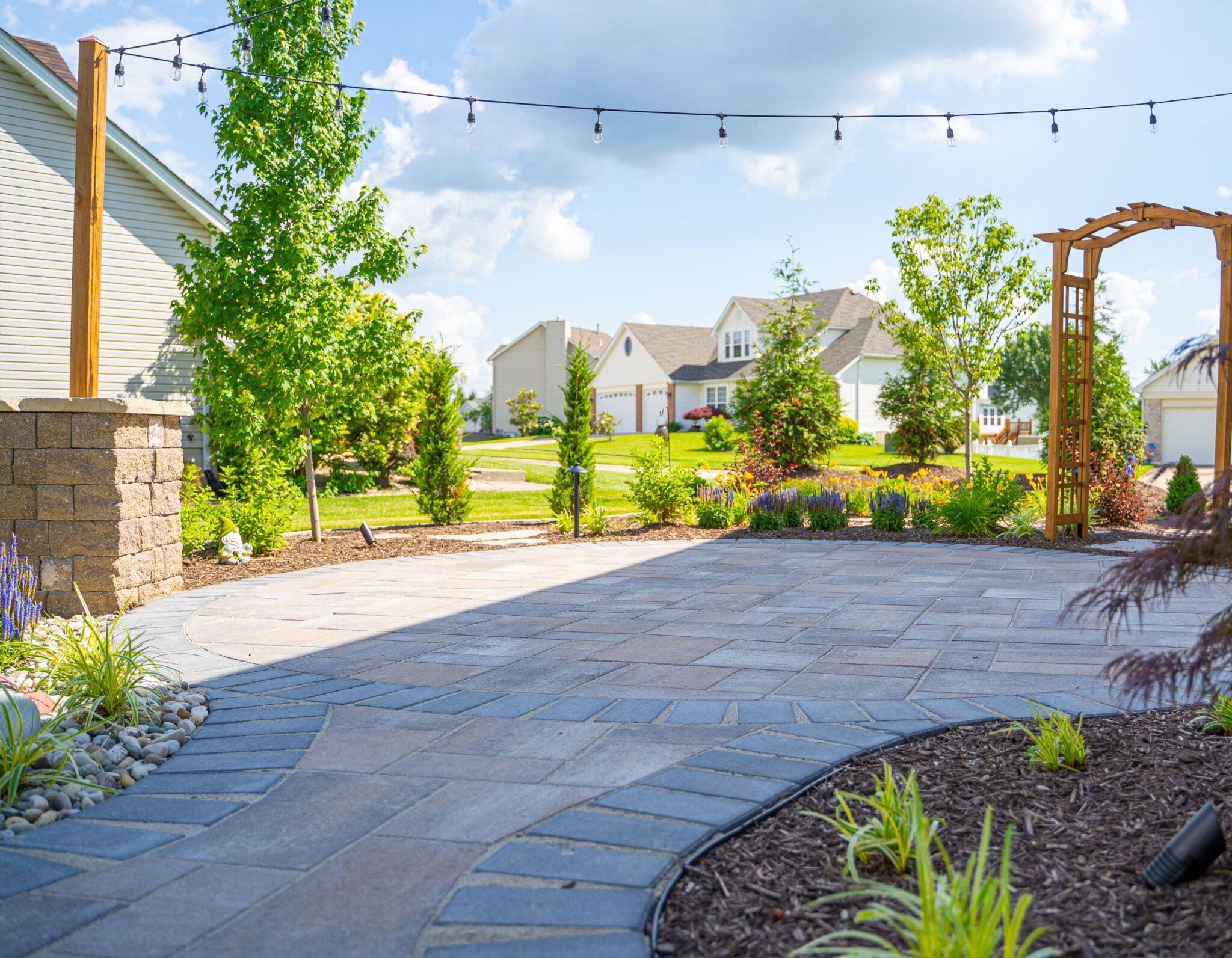


Most of the yards we renovate came with the house, which is often why the space doesn’t quite fit how you live now.
You’re not just wondering what a renovation costs, you’re weighing it against everything else on this year’s budget, and that takes real numbers, not guesses. Without them, you can’t tell a fair quote from a bad one.
So we’ve pulled together the numbers we quote, what moves them up and down, and how to decide what to prioritize first.
What Does a Landscape Renovation Cost?
The American Society of Landscape Architects suggests spending 10 to 20 percent of your home’s value on your outdoor space. For instance, on a $600,000 home, that is approximately $60,000 to $120,000 typically spent over the years you own the home. Plenty of the projects we complete land well under that because the homeowner phased the work over a few seasons.
The more useful way to budget is piece by piece. Use the ranges below as a planning guideline. What your project actually lands at depends on your site, the materials you choose, and how much prep work the yard needs first.
What you are adding | Installed cost |
|---|---|
Paver patio, concrete pavers | $30 to $40 per square foot |
Paver patio, natural stone | $40 to $50 per square foot |
Poured concrete patio | $16 to $30 per square foot |
Retaining wall | $50 to $125 per square foot |
Seat wall | $150 to $300 per linear foot |
Fire pit | $2,500 to $8,000 and up |
Outdoor kitchen | $5,000 to $30,000 and up |
Landscape lighting | $300 per fixture |
Pergola or shade structure | $13,000 to $25,000 and up |
Removing an existing concrete patio | Adds $2 to $6 per square foot |
A 400 square foot paver patio with a fire pit and six lights, which is one of the most common renovations we build, typically runs roughly $14,000 to $24,000 depending on the material you choose and how much site work your yard needs first.
Our guide to paver patio costs breaks the patio piece down by size, from a 10 by 10 up to a 20 by 30, and covers exactly what is and is not included in an installed price.
What Drives Your Landscape Renovation Cost?
Cost variances are typically driven by six factors:
Square footage of your renovation
Refreshing the front beds and rebuilding the whole backyard come with very different price tags. Before you look at materials, decide how much ground the project actually covers, because that decision sets the range everything else fits inside.Demolition and removal
Old concrete, a deck that has started to rot, a retaining wall that is leaning, shrubs with root balls the size of a beach ball. All that is separated on your quote, so the number you approve is the number you pay.Your grade, drainage, and soil
Drainage is the least visible part of a renovation and often the one that decides if the yard holds up, because water has to go somewhere. When it pools in the low corner for two days after a storm, we correct that before building anything on top of it. If the drainage work happens after the patio, you pay for that patio twice.How much of the plan is hardscape
Patios, walls, steps, and kitchens are the heaviest line items in nearly every renovation. Planting, mulch, and lawn work cost a fraction of what stone and concrete do. If your budget is fixed, adjusting the hardscape footprint moves your total far faster than trimming the plant list.Which materials you choose
Concrete pavers and natural stone both make excellent patios. The cost difference between the two is about $10 per square foot installed, which on a 400 square foot patio comes to roughly $4,000. Neither one is the wrong answer, and it is worth knowing which you are picking and why. Our guide to natural stone for paver patios compares flagstone, bluestone, limestone, granite, sandstone, and travertine on durability, climate suitability, and how much upkeep each one asks for.How easily equipment reaches the work area access
A backyard a skid steer can reach through a side gate costs less to build than one where every wheelbarrow load travels down a narrow walkway. We check access on the first visit so it lands in your quote instead of arriving later as a change order.
Should You Repair Your Patio or Replace It?
We get asked this more than almost anything else, and the honest answer often saves people a good deal of money.
Repair usually makes sense when:
- The base underneath is solid and only the surface looks tired
- A few pavers are stained, cracked, or have settled in one small area
- A wall is still holding its line and only the cap has shifted
- Your beds are structurally fine and simply overgrown
Replacement usually makes sense when:
- A concrete slab is cracking in more than one place, because a patch always shows
- A paver patio went in over a base that was never compacted properly, which shows up as waves and dips across the surface
- A wall is leaning, bulging, or letting soil wash through it
- The layout itself is the problem, and no repair changes where the patio sits
One advantage of pavers is that this rarely has to be all or nothing. When the base is sound we lift the damaged pieces, replace them, and the repair disappears. If you are trying to work out which side of the line your patio falls on, our article on whether a paver patio needs repair or replacement walks through the specific signs we look for, including uneven pavers, cracking, weed and moss growth in the joints, and standing water after rain.
What Should You Prioritize?
If you cannot do everything at once, and most people cannot, this is the order we recommend:
- Drainage and grade. Getting water moving correctly first means everything built afterward stays where you put it. Handling it second means taking that work apart to get underneath.
- Hardscape structure. Patios, walls, and steps set the shape of the yard, and they are the pieces you are least likely to want to move in five years.
- Irrigation and anything else that lives underground. Utility runs go in while the ground is already open. Trenching through a finished patio is a cost nobody enjoys paying a second time.
- Planting. Trees and shrubs are the only part of the project that improves every year you own it, so the sooner they go in, the sooner they fill out.
- Lighting and finishing details. At $300 per fixture, lighting is one of the few pieces that adds cleanly in a later season without disturbing what is already built.
Can You Renovate Your Landscape in Phases?
Yes, and a lot of our clients do. The part that matters is that we design the full yard first and then break it into phases, so every stage is working from one plan instead of a run of separate decisions.
When a yard gets built in pieces without a master plan, the pieces stop lining up. The patio ends up at the wrong elevation for the wall that arrives two years later, beds get dug up to run a wire that should have gone in during year one, and the finished yard reads like three projects rather than one place.
We design the whole space first, then build it in the order and on the timeline your budget allows. Our landscape design process page walks through the four stages we work through, from conceptual design and a to-scale detailed plan to the material palette and final revisions, plus the 3D walkthrough option if you want to see the space before we build it.
Does a Landscape Renovation Add Value to Your Home?
It absolutely does! And it is one of the improvements you get to enjoy every day while it works for you. Landscaping investments typically return 20 to 30 percent. Because the yard is the first thing anyone sees and because mature planting and built hardscape are things a buyer cannot add quickly.
A patio, the wall beside it, and the planting around it that were all drawn together read to a buyer as part of the house. The same three things added in unrelated years read as three additions.
Our guide to budgeting a landscape project covers the spending guidance above in more detail, compares plant types by maintenance level and install cost, and explains how ongoing upkeep should factor into what you invest up front.
Do You Charge for Landscape Design?
Yes. Every Elevate project is built from a design, and you can purchase it on its own before you decide to build.
The first step is a Property Assessment, where one of our outdoor living specialists walks the property with you and takes the photos and measurements our design team needs. From there, you get a to-scale plan, a material palette, a presentation meeting, up to two rounds of revisions, and a price for the build. You have the option to add on a 3D walkthrough of your design, where our team will create a simulation of what the finished space looks like.
How Do Local Conditions Change What You Pay?
We build in St. Louis, Kansas City, and the Midwest and Northeast regions, and the soil and climate are different in each.
Clay soil
Clay moves with seasonal moisture, which is why base depth under a patio is not a place to economize. A shallow base saves a little at install and costs a full rebuild later.
Seasonal freeze-thaw cycles
Freezing and thawing is hard on any rigid surface. Concrete pavers and natural stone flex slightly and stay put, and our ICPI-certified crews have been building to those standards since 2004. Poured concrete does not flex, which is why its lower upfront number often stops being the lower number somewhere around year twelve.
Slope
A grade is a cost driver and a design opportunity at the same time. A yard that falls away from the house needs retaining structure, and that same structure is what turns an unusable slope into terraces you can actually put furniture on.
Our St. Louis, Kansas City, and Adirondack region pages list the services we run in each market alongside local project examples.
Landscape Budgeting Frequently Asked Questions
A single patio project starts around $5,500, while a full backyard renovation with hardscape, planting, and lighting more commonly runs $40,000 and up. So, it depends on how much of the yard you are changing. 10 to 20 percent of your home’s value is a reasonable planning range.
Let’s bring your brand to life—contact us to start your custom landscape design.
Hardscape, in almost every project. Patios, retaining walls, steps, and outdoor kitchens carry both the material cost and the labor. Planting and lawn work usually make up a much smaller share of the total than homeowners expect.
Yes. We recommend designing the whole space first and then building in stages, so each phase connects properly to the ones before and after it.
It depends on what material your patio is constructed from. Poured concrete is almost always more costly to repair than a paver patio. For paver patios, repair is cheaper when the base is sound, and the problem is limited to the surface. When the base was never compacted properly, repair tends to become a recurring cost, and replacement is usually the better value.
Yes. Landscaping investments typically return 20 to 30 percent, and a well-designed outdoor space also makes a home noticeably more appealing to buyers.
Most of the time, a design is necessary in order to get an accurate quote for your project. Your first consultation is free, and we use it to understand the property and your goals before any design work begins.
Concrete removal adds $2 to $6 per square foot. On a 300 square foot patio, that is an additional $600 to $1,800 on top of the new installation.
Curious To Know How Much Yours Would Cost?
Then let’s come take a look. One of our designers will walk the property with you, free and with no obligation, because standing in your yard is the only way to put a real budget behind it.
Start your quote and we will set up your design visit.